



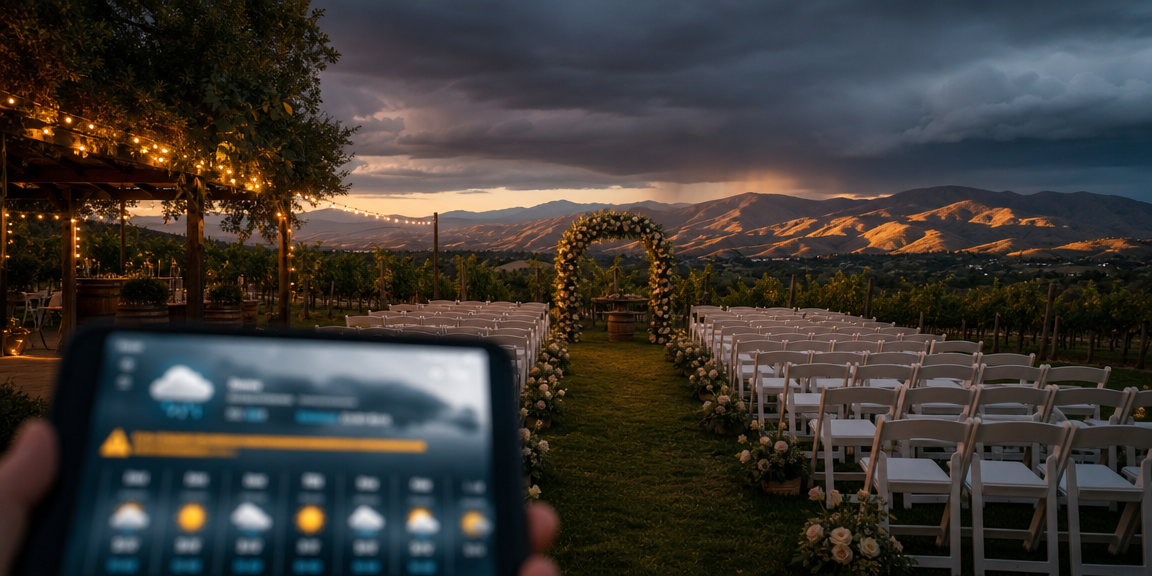
Sara has organized 50+ wedding events. She had never lost a single one to the weather.
Ten days before the Saturday ceremony, the forecast looked perfect: 28°C, a light breeze, and a few soft clouds over the vineyard. The couple wanted an outdoor wedding. They loved the long lawn, the string lights, and the hill behind the altar turning gold at sunset. Sara loved these things too. But she also knew all the ways it could go wrong in one afternoon.
Then the outlook started to change.
If you plan events for a living, you already feel the tightness in that sentence. Because for an outdoor wedding, the weather forecast is not a convenience. It is the one thing you cannot control, cannot bargain with, and cannot get a refund on. This is the story of the seventy-two hours that almost cost Sara a wedding — and what it taught her about turning weather from a threat into a promise she could keep.
Why weather is the biggest risk in outdoor event planning
Here is the uncomfortable math. Roughly 65% of wedding ceremonies are now held outdoors, according to industry data compiled by wedding-market analysts and The Knot’s real weddings research. Couples hire an average of 10 to 14 vendors for a single celebration. The average wedding in the United States now costs around $33,000, and most couples exceed their budget before the first RSVP arrives.
Now layer weather on top of all of it.
Rain is consistently named the number-one concern for outdoor events by planners and venues alike. And it is not just about a wet dress. As weather-insurance specialists point out, poor conditions cut attendance, shorten how long guests stay, and quietly reduce what they spend on food, drink, and everything else — which means the financial hit lands on vendors and sponsors, not only the host. A storm does not politely target the ceremony. It hits catering, the band’s equipment, the rental tent that was booked as a maybe, the photographer’s timeline, and the reputation of the person who signed off on “we’ll be fine outside.”
That is the real pain point behind an event planning weather forecast: it is a chain reaction. One bad call cascades into refunds, angry vendors, and a review that follows a planner’s business for years.
The quotable truth: An outdoor event doesn’t have a rain problem. It has a decision problem — and the decision is only as good as the forecast you were watching.
The countdown
T-minus 10 days: the postcard
At ten days out, most planners exhale. Sara didn’t. She had learned that a ten-day outlook is a mood, not a promise. So she kept the vineyard’s public event page — built on WordPress — showing a live weather forecast for the exact coordinates of the venue, not the nearest city thirty miles inland. The couple could see it. The guests could see it. Sara could see it update on its own, every few hours, without her refreshing a single app.
That distinction matters more than it sounds. “The weather in the region” and “the weather at the altar” are frequently two different stories, especially near coastlines, ridgelines, and valleys where a vineyard likes to sit.
T-minus 5 days: the wobble
Five days out, the models disagreed. One nudged a low-pressure system north. The temperature line on the extended forecast dipped, and a chance of precipitation appeared on Saturday afternoon — small, but there. This is the moment amateur planning breaks. The instinct is to panic or to ignore it. The professional move is to watch the trend.
Sara didn’t cancel anything. She pre-warned the tent vendor, put the marquee on a soft hold, and adjusted nothing the couple could see. A five-day weather forecast for events is most valuable not as a verdict but as a countdown clock — it tells you how much runway you have left to make a calm decision instead of a frantic one.
T-minus 48 hours: the alert
Forty-eight hours out, her phone was not the thing that saved the day. The venue’s own website was.
The live weather display refreshed, and beneath the forecast a National Weather Service alert surfaced automatically — a severe thunderstorm watch for the county, timed to roll in during what would have been the cocktail hour. No manual update. No frantic screenshot forwarded from a bridesmaid who “saw something on the news.” The government-issued alert simply appeared, credible and current, on the same page the couple had been checking obsessively for a week.
That is the difference between reacting to weather and being ahead of it. Sara activated the tent, moved the ceremony forty-five minutes earlier to open a clean window before the front, and sent one confident message to the couple instead of ten anxious ones.
The morning of: the window
Saturday arrived overcast and tense. But the hourly forecast held the line Sara had bet on: a dry corridor from 4:00 to 6:30 p.m., with the system arriving after sunset. The couple said their vows under a bruised, dramatic sky that photographed like a painting. The rain came at 7:52 p.m., exactly as the outlook promised — long after the last “I do,” while everyone was warm and dry under the marquee, toasting a wedding that almost didn’t happen the way it did.
Nobody in the crowd knew how close it had been. That is what a good forecast buys you: the luxury of a crisis your guests never see.
What separates a lucky planner from a prepared one
Luck is watching the weather. Preparation is building the weather into the event itself. The planners who sleep well before an outdoor event tend to share a few habits:
How can event planners reduce weather-related refund and reputation risk?
Event planners reduce weather risk by combining an accurate, location-specific event weather forecast with automated severe-weather alerts and a pre-built contingency plan. In practice that means monitoring a precise-coordinate forecast from ten days out, watching the trend rather than a single snapshot, enabling government weather alerts so warnings surface without manual checking, and making the forecast publicly visible on the event page so guests self-manage expectations. The goal is to move every weather decision earlier in the timeline, when it is still cheap to change course and before refunds, vendor conflicts, or reputation damage become unavoidable.
Weather is the one guest you can’t uninvite. The planners who thrive aren’t the ones who get lucky with the sky — they’re the ones who saw it coming.
Why should an event weather forecast live on your website, not just an app?
A forecast on your event or venue website does three things a phone app cannot. First, it builds trust: guests deciding whether to travel, what to wear, or whether to worry can check conditions on the same page where they bought tickets or RSVP’d. Second, it reduces the planner’s load — instead of fielding dozens of “is it going to rain?” messages, the answer is always live on the page. Third, when the forecast includes automatic National Weather Alerts, your site becomes a credible, self-updating source during exactly the moments when misinformation and panic spread fastest. For travel sites, wedding venues, festivals, sports clubs, and municipal event pages, a live weather widget turns a passive page into a daily-utility tool people return to.
The reputation dividend
Here is the part that rarely makes it into the checklists. When Sara’s couple left a review, they didn’t mention the storm — because to them, there hadn’t been one. They mentioned how calm everything felt, how nothing seemed rushed, how their planner “just handled it.” That review booked Sara three more weddings.
Weather risk, managed well, is invisible. Weather risk, managed badly, is the only thing anyone remembers. The forecast is not a widget on the corner of a page. It is the difference between the wedding that almost rained out and the wedding that rained out — and those two sentences describe the same weather and two completely different businesses.
Bring the forecast into your own event pages
If you run a venue, a wedding business, a festival, or any WordPress site where weather decides whether people show up, you can put the same advantage Sara had directly on your pages.
Location Weather by ShapedPlugin displays accurate, real-time forecasts for any exact location worldwide — with hourly and multi-day outlooks — and surfaces live, government-issued National Weather Alerts automatically, so your site stays credible through every changing sky.
No code, no manual updates, no scrambling at T-minus 48 hours.
👉 Explore Location Weather and give every event page a forecast your guests can trust.
Frequently asked questions
What is the most important weather factor for outdoor events?
Precipitation timing is usually the most critical factor, because rain affects attendance, guest comfort, vendor equipment, and revenue simultaneously. Wind and extreme temperatures follow closely, particularly for tented events and gatherings with elderly or young attendees. An hourly forecast for the exact venue location is more useful than a daily city-level outlook.
How far in advance should event planners check the weather forecast?
Begin monitoring roughly 10 days out to establish a baseline, then track the trend at 5 days and 48 hours. Extended forecasts are directional rather than exact, so the value comes from watching how the outlook shifts over time — that trend tells you when to lock in contingencies while options are still flexible and affordable.
Can a weather forecast really affect event revenue?
Yes. Poor or uncertain conditions reduce attendance, shorten how long guests stay, and lower spending on food, beverages, and merchandise — hitting vendors and sponsors as well as hosts. Clear, visible forecasting also reduces cancellations by helping guests plan travel and attire with confidence.
What are National Weather Alerts and why do they matter for events?
National Weather Alerts are official, government-issued warnings (such as severe thunderstorm or high-wind watches) for a specific area. For events, automatic alerts remove the dangerous delay of waiting for someone to notice a warning, giving planners time to shelter guests, adjust timelines, or activate a backup plan before conditions turn.
How can I show a live weather forecast on my WordPress event page?
A WordPress weather plugin such as Location Weather lets you display a real-time, location-specific forecast — along with automatic National Weather Alerts — on any page, post, or venue listing without coding. You set the exact location once, and the forecast updates on its own.



Leave a Reply